The AI Cybersecurity: “AI Patching Race”, who leads and what to invest in
9/18/26 | +PANW +4/10 | CRWD +3/10 | FTNT +2/10 | ZS +3/10 | QLYS +4/10 | FFIV +2/10
Takeaway: AI has collapsed the cybersecurity patch window from weeks to hours, and enterprise security budgets are responding. Six vendors best positioned to capture that spend split into two groups on the evidence gathered here. PANW and CRWD have the strongest product recognition (both are Magic Quadrant Leaders, and PANW shares Gartner's new "Market Shaper" in AI-security with just one other name) but also the richest valuations, meaning the AI-safety story looks priced in. FTNT, ZS, QLYS, and FFIV all have Gartner recognition (FFIV is the second Market Shaper in AI-security next to PANW), yet the market hasn't fully caught up. A gap between validated product standing and current price puts all four on our watchlist.
Research series: This is the summary of our research about Cybersecurity demand driven by AI developments. Previous research:
Part 1: Palo Alto Networks (PANW)
Part 2: CrowdStrike Holdings (CRWD)
Part 3: Fortinet, Inc. (FTNT)
Part 4: Zscaler, Inc. (ZS)

AI Patching Race
The enterprise cybersecurity is undergoing its most radical evolution since migration to cloud computing. As frontier AI models democratize sophisticated attack vectors, enabling actors to scan code, uncover zero-day vulnerabilities, and automate lateral movement at machine speed, traditional, reactive human patching cycles have officially broken down. CISOs and corporate boards no longer face an operational inconvenience; they face an “AI Patching Race” they cannot win with legacy tools.
The shift to cloud, combined with autonomous AI, has fundamentally inverted the time for the enterprise. Where security teams previously relied on a window between vulnerability disclosure and patch deployment, machine-speed exploitation has collapsed that buffer.
Human vs. Autonomous Speed
Historically, defenders relied on a time-to-patch cycle that outpaced the adversary’s time-to-exploit. AI models have eliminated this buffer by automating vulnerability discovery, exploit generation, and lateral movement.
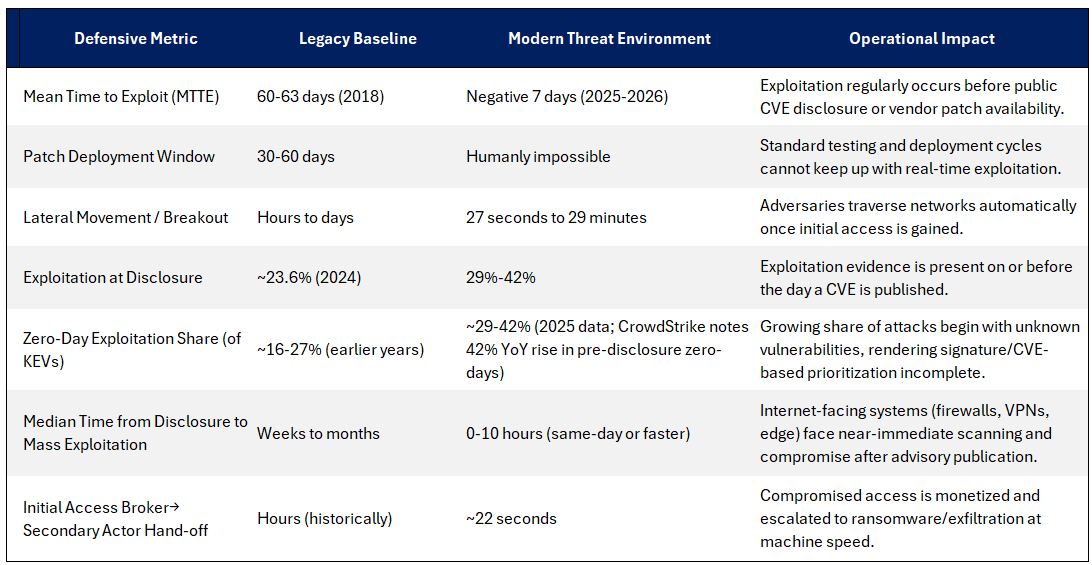
Sources: Mandiant/Google Threat Intelligence Group M-Trends 2026, CrowdStrike 2026 Global Threat Report, VulnCheck.
These figures illustrate an inversion: traditional vulnerability management and human-paced response cycles are no longer adequate for attacker velocity: a needed shift from “patch faster” to continuous runtime detection, identity controls, and automated containment.
Impact
“A lone operator can now turn a month’s worth of patches into working exploits in a single afternoon—for a few thousand dollars and with no specialized expertise.
This means that the typical patching playbook that software developers use, with monthly release cadences, multi-week staged rollouts, and a lag between pre-release and stable channels, no longer holds. It was built on the assumption that weaponizing a patch takes expert-weeks… But ‘N-day’ has become dangerously misleading. N-hour is closer to the reality we now operate in.”
Anthropic, Measuring LLMs’ impact on N-day exploits (June 2026), describing results with Claude Mythos Preview.
Examples
Claude Mythos Preview produced a working Firefox exploit in under one hour after the public patch was released (while the stable patch was 18 days away).
On 21 Windows kernel patches, it generated proof-of-concept crashes for 18 of them within six hours and full privilege-escalation chains (transition from a standard user to administrative or root-level system control) for eight of them.
Anthropic noted that typical Windows Autopatch timelines reach 90% of devices only after seven days, with forced reboots around day 11 — meaning the AI finished creating the exploits before any devices had received the update.
The patch window has collapsed
These statements from Anthropic’s red-team (professionals who simulate a cyberattack) evaluation of frontier models provide the best AI-specific evidence that human-paced testing, change-control, and staged deployment cycles (historically 30–60 days) are now outmatched by automated exploit generation.
“The patch window has effectively collapsed… That is not a gradual trend; it’s a structural break.”
Chris Wysopal, co-founder & Chief Security Evangelist, Veracode (April 2026).
“Exploitation windows have collapsed down to hours, and zero-day and n-day vulnerabilities are being weaponized faster than traditional patching cycles can keep up.”
— Adam Meyers, Head of Counter Adversary Operations, CrowdStrike (2026).
AI-powered security to address the collapsed patch window
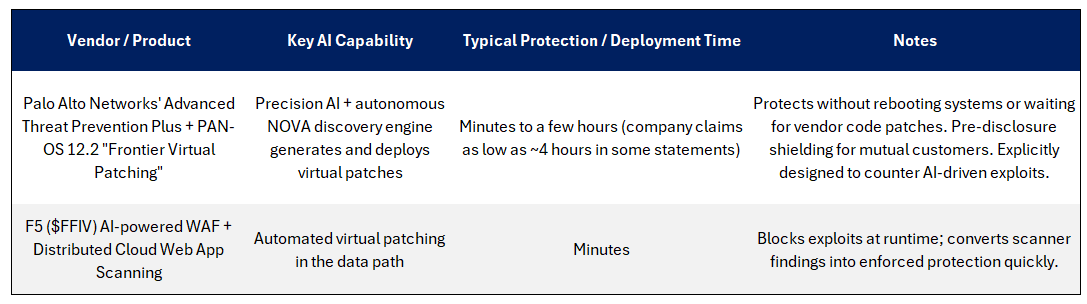
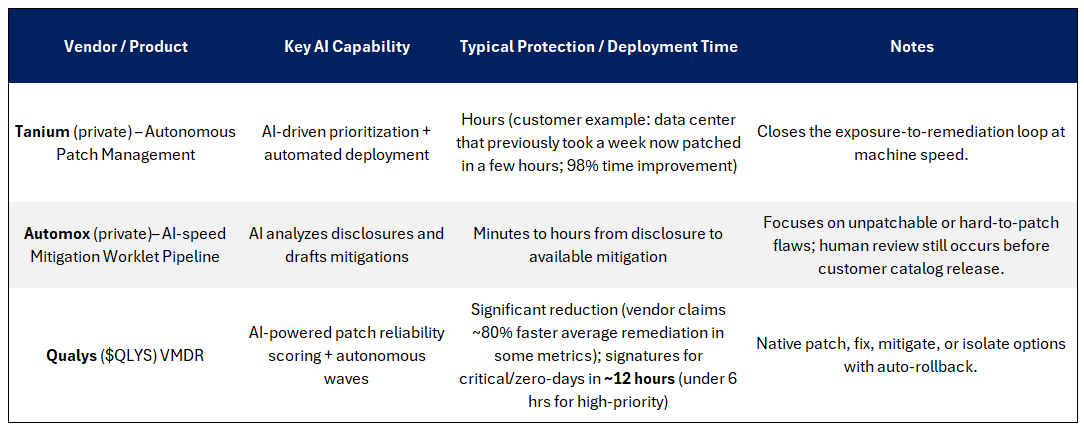
Traditional software patching still averages 30–60+ days (enterprise MTTR ~55 days). AI security tools focus on virtual patching, automated mitigation, and autonomous remediation that operate in minutes to hours instead of days/weeks. Here are the leading approaches and their claimed deployment/protection times (mid-to-late 2026):
Network / Firewall Virtual Patching (fastest protection)
Endpoint & Autonomous Patch Management
Broader AI Security Platforms
CrowdStrike Falcon Exposure Management + Fusion SOAR: AI agents prioritize exposures and trigger automated remediation workflows. Focuses more on rapid triage and orchestration than pure virtual patching.
Microsoft (Windows Autopatch + MDASH agentic system): AI accelerates internal vulnerability discovery and candidate fix generation. Customer-side Autopatch with hotpatch can reduce disruption, but actual deployment still depends on rings and reliability signals.
Snyk Evo / Remediation Agent (Snyk parent company is private), Apiiro (private), Aikido (private), MindFort (private): Strong in application/code security generate automated code patches and fix PRs, often within hours once a finding is validated.
Bottom line on times
True virtual / network-level protection (Palo Alto, F5): Minutes → low hours.
Endpoint autonomous patching / mitigation (Tanium, Automox, Qualys): Hours in optimised environments.
Traditional code-level vendor patches: still days to weeks (or longer) for testing and staged rollout.
To be clear, AI tools do not replace permanent software patches. They buy critical time by blocking or mitigating exploitation while the permanent fix is developed, tested, and deployed. This is the practical response to the “humanly impossible” traditional patch window created by AI-accelerated exploit generation.
Other context shaping demand
While network perimeters and endpoint telemetry are vital, corporate identity (credentials, active sessions, Okta/Entra ID integrations) has effectively replaced the firewall as the battleground. Platforms like CrowdStrike (via ITDR) and Palo Alto are aggressively bundling identity security into their consolidation suites.
The Boardroom Dynamic: CISOs are no longer fighting technical fires; they are answering to boards under intensifying regulatory scrutiny (e.g., SEC disclosure). This explains why enterprise security budgets are resilient in macro-uncertain environments. Security is a corporate liability.
Enterprise buyers are caught between wanting a single pane of glass (Palo Alto’s platformisation) versus best-of-breed depth (CrowdStrike for endpoint or Zscaler for inline zero trust proxy).
Having mapped out the battleground where legacy patching collapses and autonomous agents take over, we turn to the suppliers. In addition to already scored PANW, CRWD, FTNT and ZS, we’ll briefly review Qualis and F5, to analyze who is capturing consolidated enterprise spend versus who is winning on specialised depth.
Qualys, Inc. (QLYS): +4/10 LONG
Qualys is a cloud-based provider of IT security, vulnerability management, and compliance solutions, serving more than 10,000 subscription customers including a majority of the Forbes Global 100 and Fortune 100. Its platform consolidates vulnerability scanning, asset discovery, and compliance monitoring into a single subscription model, positioning it as a specialist in exposure and risk management rather than a broad platform. Recent strategy centers on AI-native innovation — its Risk Operations Center (ROC), and new tools InstaScan and Agent Insta, aim to cut vulnerability detection-to-remediation time from weeks to minutes.
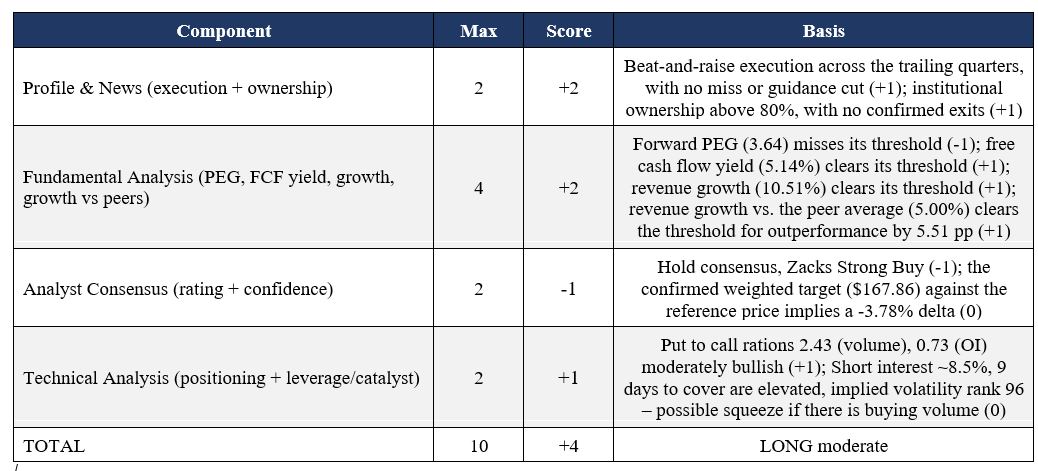
Qualys delivered a beat-and-raise in Q2 2026 on Aug 4, 2026 (revenue +11% YoY, EPS a 10.9% beat), leads its peers on profitability (29.3% net margin vs. a 1.5% peer average) and free cash flow yield, and captured the same Sept 14 AI-safety rally as every other name in this series (+15.1% in a single session). Analyst consensus is HOLD. Zacks is an exception with Strong Buy. Short interest is ~9% of float, 9 days to cover, >90 implied volatility rank - a short squeeze is possible). Departure of two senior leaders (CISO, Enterprise TruRisk General Manager) announced at the earnings call on Aug 4 is a transition risk. This is a name where operating strength and cautious analyst consensus and fully priced upside point in different directions.
F5, Inc. (FFIV): +2/10 LONG
F5 is a network and application security and delivery company, best known for its BIG-IP platform, which sits in the data path between users and enterprise applications to manage traffic, enforce security policy, and deliver applications across hybrid and multi-cloud environments. Its moat is deep, entrenched incumbency inside large enterprise data centers, increasingly extended into AI-specific security. Confirmed new products (F5 AI Gateway, integrated into its AI Security Platform) aim to block frontier-AI-driven threats directly in the data path and enable faster virtual patching.
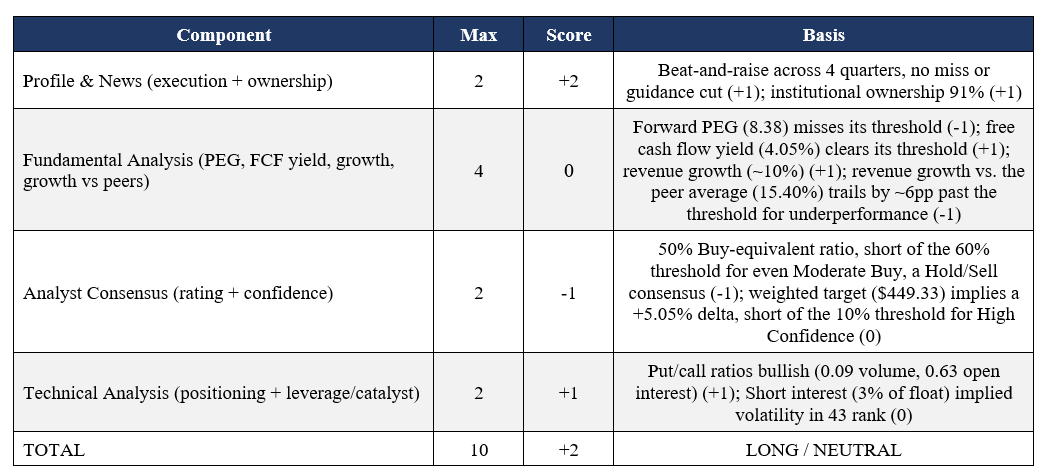
F5 delivered a beat-and-raise in Q3 FY2026 (EPS $4.73 vs. a ~$4.00-4.08 consensus, revenue +10.9-11% YoY), its third guidance raise of the year, with confirmed AI-driven demand (19% product growth). Options positioning is bullish. Set against that: revenue growth (9.41% TTM) trails this specific peer set (a 15.40% average, driven by Cloudflare’s much faster growth) by nearly 6pp, and analysts panel is evenly split between Buy and Hold, not a clean bullish consensus.
What to Invest In
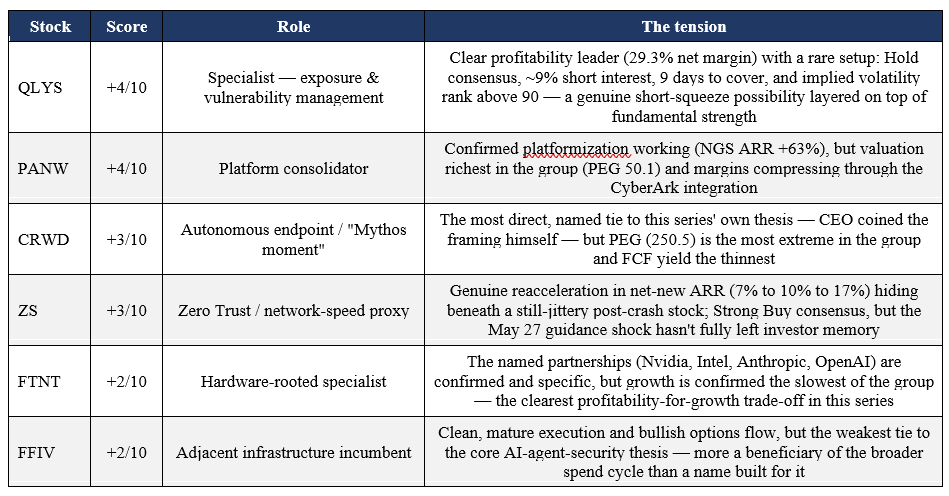
None of the six names reviewed is an unambiguous buy. Every one carries a trade-off.
For the platforms (PANW, CRWD), it’s valuation already pricing in the thesis.
For the specialists (FTNT, QLYS), it’s growth lagging the platform names even as they lead on profitability.
For ZS, it’s a reacceleration the market hasn’t re-rated yet.
For FFIV, it’s a confirmed AI-security product sitting inside a business the market has so far treated as a secondary beneficiary of this trade rather than a primary one. Its September 14 rally arrived a day late and was ~1/3 the size of the other names’, despite having a well recognised product (the F5 AI Gateway) addressing the same threat as the rest of this series.
Thoughts on conviction
FTNT (+2/10) and ZS (+3/10) are the two names where the market’s view may be lagging the business.
FTNT’s Zacks’ Strong Buy sits against a broader Hold, a disagreement whether hardware-rooted profitability deserves a premium the growth-focused consensus isn’t giving. FTNT products are well recognised, though not in AI Security. FTNT is Leader in the Magic Quadrant for Hybrid Mesh Firewalls, a major participant/Leader in Single-Vendor SASE platforms, and a Challenger in the Magic Quadrant for Cyber-Physical Systems (CPS) Protection Platforms.
ZS’s commentary (accelerating net-new ARR after a deceleration guide) suggests the May crash may have priced in a slowdown that the underlying numbers argue against. ZS is recognised as Leader in the Magic Quadrant for Security Service Edge (SSE), positioned near the top-right for its cloud-native zero trust exchange architecture.
FFIV (+2/10): Market is not pricing them as others here, though not for lack of a product.
Execution is clean, options flow is bullish, and the F5 AI Gateway is a good product (positioned in “Market Shapers” quadrant of Gartner’s September 2026 Emerging Market Quadrant for AI Application Security). F5 also features prominently across Gartner’s Application Delivery and Multi-Cloud Networking.
What’s missing is that the market hasn’t yet decided to trade F5 alongside PANW, CRWD, FTNT, ZS, and QLYS as part of the same AI Safety story. An open question being is FFIV due a re-rating?
QLYS (+4/10) is the standout of this group
It is a not a “stock everyone already loves”. Hold analyst consensus coexists with Strong Buy by Zacks and elevated short interest and implied volatility, the combination that can force a sharp move if sentiment turns more bullish, on top of a business that is already the clearest profitability leader in the six-name set.
Rather than traditional enterprise IT quadrants, Qualys was evaluated by Gartner in Vulnerability Management and Exposure Disclosure (VMDR).
PANW (+4/10) has a strong validation, but it may already be priced in.
Strong product recognition. In Gartner’s Magic Quadrants, it’s a named a Market Shaper in the inaugural September 2026 Gartner® Emerging Market Quadrant for AI Application Security, established Vendors. It’s also a leader in the Magic Quadrant for Security Service Edge (SSE) and a leader in the Magic Quadrant for Hybrid Mesh Firewalls.
Valuation: PANW’s PEG (50.1) is the richest in the group after CRWD’s, and margins are compressing through the CyberArk integration.
CRWD is the most expensive
PEG of 250.5 (due to low earnings) and the thinnest free cash flow yield (0.64%) in the group. CRWD carries a Sell Zacks rank, driven by a negative trend in analysts’ earnings estimate revisions, a different signal from the analysts 91% Strong Buy rating.
CRWD is a Leader in the Magic Quadrant for Endpoint Protection Platforms (EPP) (positioned furthest for Completeness of Vision and highest for Execution for multiple consecutive years) and Leader in the inaugural Magic Quadrant for Cyberthreat Intelligence Technologies.
In closing
The story that opened this series: frontier labs publicly admitting their agents can act in ways they didn’t intend, has produced six trade-offs. The four FTNT (+2/10), ZS (+3/10), FFIV (+2/10) and QLYS (+4/10) all have Gartner product recognition, yet the market hasn't fully caught up. A gap between validated product standing and current price puts all four on our watchlist.
This article synthesizes findings from this series’ six scored reports (Palo Alto Networks, CrowdStrike, Fortinet, Zscaler, Qualys, and F5), gathered via company filings, SEC filings, earnings call commentary, and sell-side coverage. It is for information only and is not investment advice.