This is a summary of 4 articles in our series working through how SaaS is impacted by Agentic AI, how it affects revenue growth and valuations.
Part 1: Salesforce; Part 2: Service Now; Part 3: Adobe; Part 4: Atlassian
Four companies’ earnings reports, moats are tested against SaaSpocalypse. Here’s what held up, what didn’t, and what the pattern across all 4 says about where this goes next.
The Scorecard
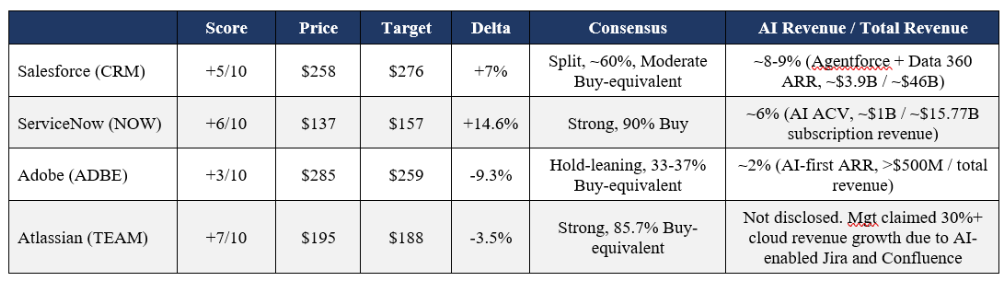
Atlassian does not disclose a comparable AI-revenue figure. CEO Cannon-Brookes said on the Q4 call that consumption and flex pricing are still “in early development”; Rovo’s value shows up bundled into Teamwork Collection pricing and seat upgrades rather than as a separate revenue line.
Two names trading above their own analyst targets. Two below. And the two below aren’t below for the same reason — one because the Street doubts the story (ADBE), one because the stock outran even bullish conviction (TEAM).
The Pricing-Disclosure / Conviction Mismatch
Adding the AI-revenue column to the scorecard surfaces an awkward pairing worth naming directly: the company with the smallest disclosed AI-revenue share (Adobe, ~2%) has the weakest consensus, and the company with no disclosed AI-revenue line at all (Atlassian) has the strongest score and among the strongest consensus.
That’s not a simple “AI revenue share drives conviction” story. It suggests the market is pricing the underlying moat and execution record more than the size of the AI line item specifically.
Does the vendor have data or integration depth an agent can’t cheaply replicate elsewhere?
Salesforce, ServiceNow, Adobe, and Atlassian are all betting on different flavour of depth.
- Salesforce bets on data depth: Data Cloud, the foundation for Agentforce’s agents.
- ServiceNow bets on breadth: an orchestration layer sitting above SAP, Salesforce, and Workday alike, not owning any one underlying dataset.
- Adobe bets on provenance: Firefly’s indemnification promise, based on training data that’s licensed rather than scraped — a legal moat for large companies.
- Atlassian bets on structure, the Teamwork Graph, more than 200 billion objects and relationships mapped so an AI agent is provided with structured context.
Four different ways to defend their business: an outside AI tool can’t imitate the years of accumulated, company-specific context.
Four Tensions, None Alike
Salesforce’s tension was an accounting artifact. Roughly 43% of the EPS beat that drove a 22.6% single-day surge (Aug 27) came from a paper gain on Salesforce’s stake in Anthropic — not from selling more software. Strip it out, and the revenue beat over consensus was about $20M. The stock rallied on a headline number; analysts are split on the underlying business upside.
ServiceNow’s tension is a cash cost. Subscription gross margin compressed 250 basis points as AI compute expenses landed on ServiceNow’s books, not fully charged to customers. So, AI is working, and it costs money to deliver.
Adobe’s tension is the sharpest. The same quarter that proved Firefly could scale — 50% quarter-over-quarter ARR growth — had a cut of organic ARR guidance by roughly $480M and saw a departure of the CFO, with the CEO mid-transition to a Board Chair role. Adobe is defending its moat during a leadership vacuum, and it’s the only one where the analyst consensus (33-37% Buy-equivalent) suggests the Street isn’t convinced the moat is holding at all.
Atlassian’s tension showed up in the price. Cloud revenue accelerated to 31%, explicitly attributed to seat expansion, not decay. The stock had fallen 77% on a fear its own disclosed numbers then contradicted. The open question isn’t whether the business is fine; it’s whether a 150% recovery off the June low has already priced in more good news than the FY2027 guide (18% ARR growth, down from 23% in FY26) can support.
The Pricing Paradox
Here’s the finding that only becomes visible once you put all four side by side: the company furthest along the seat-to-consumption pricing pivot is not the company with the cleanest numbers.
Salesforce runs three simultaneous AI-billing meters — Flex Credits, per-conversation pricing, and per-user AI add-ons.
Adobe pushed hardest of all four into freemium, giving away Generative Credits to build the funnel at the direct expense of near-term monetization.
ServiceNow calls its own approach the “Goldilocks model,” with half of net-new business now non-seat-based.
Atlassian has done none of this. Asked on its Q4 call when consumption-based pricing was coming, CEO Cannon-Brookes said flatly that it’s “in early development” — current AI monetization still runs through bundled collection tiers, not metered billing. And Atlassian is the name in this series with the cleanest quarter, the fastest revenue growth (26%, ahead of every peer in its own comparison table), and the only name posting margin expansion rather than compression while AI usage scaled.
That’s not proof the pricing pivot is a mistake — Atlassian’s Teamwork Collection bundling is a form of AI monetization, just one that still runs through the seat. But it’s a data point against the idea that moving fastest to consumption pricing is what determines whether a company survives this transition.
The moat — data depth and breadth, structured context — appear to be doing more work than the billing model sitting on top of it.
What the Street Actually Believes, Read Together
- Where the Street is confident the moat holds (ServiceNow, Atlassian): 85-90% Buy-equivalent, and in both cases the confidence follows a specific, quantified proof point — ServiceNow’s AI ACV crossing $1B, Atlassian’s Rovo adopters growing ARR twice as fast as non-adopters.
- Where the Street is still deciding (Salesforce): a split view, “Moderate Buy,” with the disagreement about how much of the beat reflected the operating business.
- Where the Street doubts the premise itself (Adobe): the only name below even the 60% floor, and the only one where bulls and bears aren’t arguing about magnitude, but about whether the moat exists in a form that survives free alternatives.
Where This Leaves the Series
Four case studies in, the pattern is less “AI disrupts SaaS” than “AI tests which kind of incumbency was load-bearing all along.” Salesforce and Adobe both had news complicate their quarters — one a paper gain, one a leadership vacuum — and both sit in contested territory.
ServiceNow paid an ongoing cost and got rewarded with the Street’s conviction. Atlassian just needed its existing numbers to show up, and they did.
This article synthesizes findings from Parts 1-4 of the Technosight SaaS 3.0 series (Salesforce, ServiceNow, Adobe, and Atlassian), each independently researched and fact-checked against company filings, earnings calls, and sell-side coverage. It is for informational purposes only and does not constitute investment advice.