This article is building on 4 research pieces about the bottleneck in the datacom optics value chain, which has driven its stocks to 10-100x rallies, and subsequently has retested for potentially interesting entries.
AI and Laser Shortage, Part 1: AXTI’s answer from the top of the datacom optics value chain
AI and the Laser Shortage, Part 2: Coherent has the best story, but market is not convinced
Applied Optoelectronics, Inc (AAOI): +5/10 Long
Lumentum Holdings Inc. (LITE): +5/10 LONG
This shortage caused rallies from mid - end 2025 to mid 2026 (AXTI - 10,700%; LITE - 2,400%; AAOI -1,160%, COHR - 830%). By now, the stocks had their retests (45-70% down from mid-2026 highs), caused by deteriorating fundamentals due to higher capital intensity and working capital required to handle the shortages, and resulting bearish sentiment.
So the question: how high is the confidence these stocks will rally again?
What is the issue and how it relates to the AI infrastructure cycle?
AI data centers need to move high amounts of data between GPUs, and that demand is driving the networking equipment industry to make each port faster: global shipments of transceivers running at 800G (gigabits per second) or above are projected to jump from roughly 24M units in 2025 to nearly 63M in 2026 (+163%), and the share of shipments at that speed is climbing from ~20% in 2024 to >60% by 2026 (source: TrendForce).
One Nvidia GB200 AI server rack requires 162 separate 1.6T (terabits per second, the next step in bandwidth from 800G) transceivers to move data internally.
These transceivers work by converting electrical signals into light and back again, and the component that generates that light, the laser, is built on indium phosphide (InP), a material only 3 companies produce at scale (80% market share between the 3).
What is Indium Phosphide, and why is it scarce?
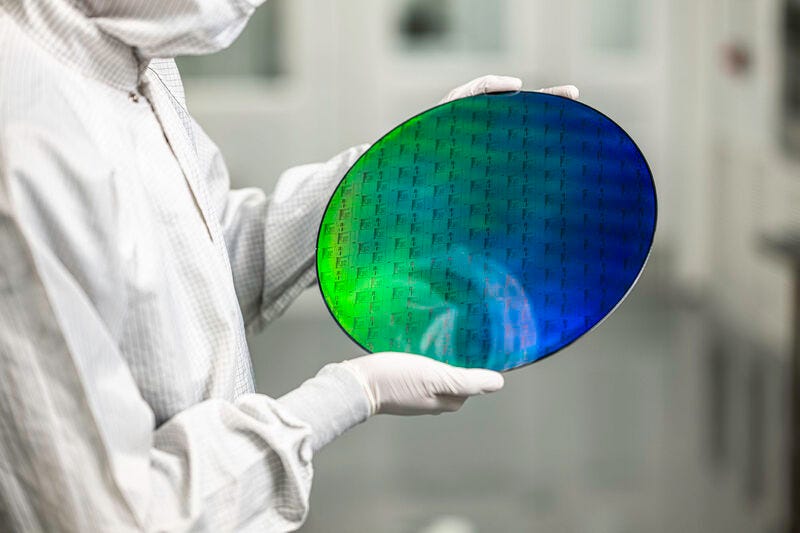
Indium phosphide is a semiconductor material that can generate and amplify light, which silicon cannot do well. That property is why InP sits underneath most of the high-speed lasers carrying data across fiber-optic networks and, increasingly, inside AI data centers themselves, where information has to move between clusters of GPUs faster than copper wiring can manage.
Making a usable piece of InP starts with a wafer: a thin, round slice from a crystal that’s grown from molten material inside a furnace over several days.
This crystal-growing step is the bottleneck in this story. Industry-wide, only ~15-25% of a grown crystal survives as usable wafer, the rest is discarded.
You cannot fix a yield ceiling by building more furnaces; you can only run more furnaces into the same ceiling.
AXT’s reported order backlog for InP wafers exceeded $60 million (~50% of their annual revenue), despite 25% increase in capacity since October 2025.
Three companies — AXT, Sumitomo Electric, and JX Advanced Metals — together supply ~80% of the world’s InP substrate. That concentration, layered on top of the yield problem, is the reason this shortage hasn’t resolved quickly despite investments.
As a result, InP price risen 190-250% p.a.
2-inch optical communication-grade InP wafers (BigGo Finance, dated Apr 25, 2026): price rose from $800/wafer in early 2025 to $2,300–2,500/wafer by April 2026, a 188–213% increase.
6-inch InP wafers: price is up 250% to roughly $5,000
In addition to AI-driven demand, price increases are also tied to China’s February 2025 export restrictions as manufacturing facilities are based there.
Why the 3 substrate makers don’t build capacity and end the shortage?
AXT completed manufacturing expansion that doubled 4-inch and 6-inch InP capacity by February 2025. Since October 2025, it has added a further 25% capacity. Separately, the company has stated it’s “on track to double InP production capacity by the end of 2026” following the $632.5 million capital raise in April 2026 to fund further expansion and R&D into new 6-inch products.
Sumitomo is expanding too, though on a slower multi-year timeline. Sumitomo Electric announced in July 2026 ~$120 million investment to upgrade production lines, targeting InP substrate capacity of 3 times its 2024 level by 2028
JX Advanced Metals (the smallest of the 3, with ~10% market share) announced plans to expand capacity by 2030 7-10 times vs 2025. It’s committed InP-related investment to date ~$936M (June 16, 2026 release).
New capacity doesn’t arrive on one timeline — most of it will continue to be delivered by 2028-2030.
The new capacity is being built specifically as 6-inch substrate lines, because larger wafers yield more usable die per production run and lower the cost per finished chip. This trend is matching where networking-equipment demand itself is shifting (800G and 1.6T transceivers rely on 6-inch production).
It’s less clear what will happen with the installed base on smaller 2-inch and 4-inch formats that dominated the industry historically. That reallocation may be part of why the older 2-inch wafer segment saw its own price roughly triple — from $800 to $2,300–2,500 per wafer between early 2025 and April 2026.
The value chain
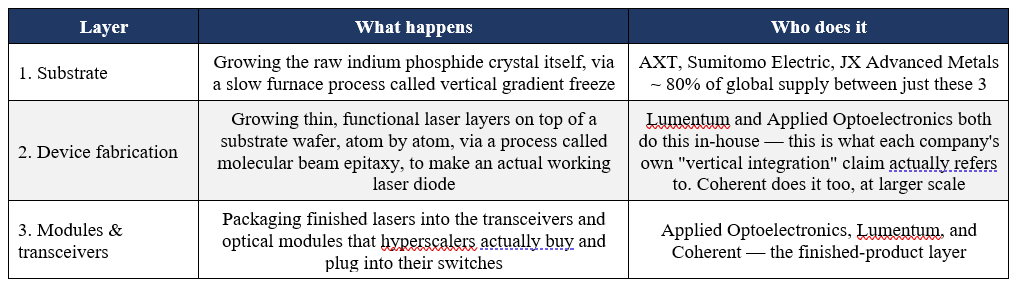
Layer 1 grows crystals and uses them to cut and polish thin substrate wafers.
Layer 2 grows compound-semiconductor layers (lithography, depositing and etching) on top of the substrate and manufactures laser diodes.
Layer 3 packages finished lasers into modules usable in datacentre equipment.
AXT operates at Layer 1, which is at the centre of InP shortage.
Lumentum, AAOI, and Coherent are ‘vertically integrated’ across Layers 2 and 3. This integration gives them an edge over competitors who buy laser chips from someone else. All three are customers of Layer 1, which is how they are impacted by the shortage.
AXT: is being at the chokepoint beneficial?
AXT makes the substrate as one of only three suppliers of the material controlling ~80% of supply. If proximity to scarcity were the most important factor, this should be the best investment of the four.
The numbers say: not yet. AXT’s stock was up roughly 10,700% from a 2025 low near $1.30 to its May 2026 peak of $143.16 — one of the more extreme moves in this research.
That rally priced in a great deal of good news:
The stock carries a forward PEG (valuation-to-growth) ratio above 16x, while we use under 1.5x as reasonably priced
Its free cash flow yield is negative, even as the company funds the $632.5 million to keep pace with its the demand.
Revenue growth of 45.8%, ahead of its peers, confirms AXT is capturing pricing power from its position — but being at the chokepoint exposes the company to expensive-to-scale 15 - 25% crystal yield.
Options markets are bullish (today’s put to call ratio 0.49 volume/short term, 0.62 OI/longer term).
We scored AXT +4/10.
Lumentum: downstream of the chokepoint
Nvidia bought its way for access to optics modules at two of the few companies that produce them. In March 2026, Nvidia committed to a multi-billion-dollar purchase agreement with Lumentum alongside a $2 billion direct investment in Lumentum’s manufacturing capacity — announced the same day as an identical $2 billion investment in Coherent. Both stocks jumped double digits the day it was announced.
Purchase agreement with Nvidia is a big reason for Lumentum’s execution record for four consecutive quarters, and why the company posts the fastest revenue growth in this story (83.2%).
What Lumentum hasn’t yet delivered is free cash flow to match the market rally.
Its own options market is sending a bearish signal (Put to call ratios 1 (volume / short term); 1.33 (open interest / longer term) as investors have built up downside protection.
We scored LITE +5/10.
AAOI: the smallest, least-capitalized name in the chain
AAOI’s capital spending runs at 47.2 percent of revenue, roughly eight times its peer average, funding a production ramp targeting of 800G and 1.6T optical transceivers.
Confirmed by CFO Stefan Murry on an earnings call:
"Monthly production capacity … will increase from approximately 100,000 units at the end of Q1 [2026] to over 930,000 units by the end of 2027."
Its revenue growth is 61.8%, ahead of peers, on a fifth consecutive quarter of record revenue.
But the company cannot yet fund that growth from its operations, which is why it has now raised equity three times in a single year, most recently for $600+ million, and why its free cash flow yield is negative -4.6%.
This is a good example what it costs to expand into a scarce, expensive-to-scale input from a smaller starting position than your larger competitors.
Lumentum has Nvidia’s capital behind its expansion. AAOI’s shareholders were diluted three times over, which has shown on the chart.
Options traders are bullish (Put to call ratio 0.35 volume/short term and 0.88 on open interest/longer term).
We scored AAOI +5/10 Long.
Coherent: the best story but weak execution
Coherent is the largest, most diversified, and most customer-validated name in this analysis. Its headline facts are the strongest.
It holds the same Nvidia relationship as Lumentum — a $2 billion investment paired with a multi-year co-packaged optics supply agreement extending, in the words of Coherent’s CFO, “through the end of the decade.”
Its CEO called it an expansion of “our 20-year relationship with Nvidia,” not a new partnership forged under pressure.
Coherent is also AXT’s customer, under a three-year supply agreement for 6-inch InP wafers signed in June 2026.
Its most recent quarter (August 2026), was a beat-and-raise, with management pointing to customer order visibility extending into calendar 2028.
On our scoring framework, Coherent comes out with the weakest result of the four (+2/10).
The reason is a miss three months before that record quarter, Coherent’s Q3 FY2026 results fell short of both revenue and profit, triggering a stock decline of 6-7%.
Revenue growth (22.5%) is below its peer group by nearly 15 pp, and an analyst consensus that just falls short of Strong Buy rating.
Its options market is neutral to bearish: put to call ratio 0.91 (volume / short term); 1.22 (OI / longer term).
The Finding
Line these four companies up side by side, and proximity to the chokepoint did not predict which investment case held up best. What separated the four was execution consistency, and how much confidence the market had already priced into each name. AXT and Lumentum both delivered uninterrupted execution records. Coherent’s best-in-class relationships sat next to a recent miss. AAOI showed what it costs a smaller company to fund its way through a major shortage.
How confident are we in another rally?
The case for a rally happening holds up: two of the three substrate makers reach their major capacity targets by 2028, and the largest commitments (JX’s 7-10x target, Sumitomo’s 3 x target) don’t land until 2030.
As the shortage doesn’t meaningfully ease for two to four more years, the case for these stocks re-rating again isn’t gone — it’s a question of when.
AXT and Lumentum earned their higher scores (+4 and +5) the same way — strong execution, which is the closest thing to evidence a rally would be built on demonstrated delivery, not just a scarcity story.
AAOI’s case for a rally holds up but looks different in kind: its own +5 score leans on options positioning and a production ramp already backed by hundreds of millions in confirmed orders, not on a strong balance sheet — a rally here is more plausible on momentum than on valuation support.
Coherent is the one name where the confidence is weakest despite the best headline story: a recent miss, growth trailing peers, and an analyst consensus that hasn’t yet reached Strong Buy all suggest the market is looking for something concrete.
So: high confidence that the underlying scarcity persists long enough. Meaningfully lower, uneven confidence in which of these four names is positioned best. On the evidence gathered here, we back execution and market sentiment (AXT, AAOI).
This article draws on independent research into AXT, Lumentum Holdings, Applied Optoelectronics, and Coherent Corporation, each built from company filings, earnings calls, and sell-side coverage. It is for informational purposes only and does not constitute investment advice. All data is subject to revision.