Takeaway: The four scored companies (TSM -2.02%↓, KLIC -1.77%↓, ASX -1.82%↓, TER -2.82%↓ ) all grow strongly, but in each case received a moderate rather than high-conviction score. Looking into the latest developments, the bottlenecks are deepening across four fronts (substrate, glass, thermal, and optics), and the most interesting additional name is Corning (GLW), sitting at the intersection of two trends (glass and optics) with Nvidia partnership behind it, but its score is a modest +2/10.
Research series: Our research on Advanced Packaging so far surfaced major names with moderate scores. All of them grow strongly, but each also has a blemish (a miss, bearish options, lagging analyst rating, guidance cut).
Part 1: TSMC (TSM -2.02%↓ )+5/10. FCF yield thin despite strong growth, options bearish.
Part 2: Kulicke & Soffa (KLIC -1.77%↓) +5/10. Analyst Consensus is Hold; 3 analysts raised targets the same week; Zacks recent upgrade from Hold to Strong Buy.
Part 3: ASE Technology Holding Co. (ASX -1.82%↓ ) +4/10. Q1 miss inside the six-month lookback despite clean quarters on either side; Institutional ADR ownership low as stock is listed in Taiwan.
Teradyne, Inc: Part 4 (TER -2.82%↓) +3/10. Beat and Lower: Q2 beat, but Q3 guidance cut from $2.47 to a $2.00 midpoint. Low (1.5%) FCF yield. Options bearish.
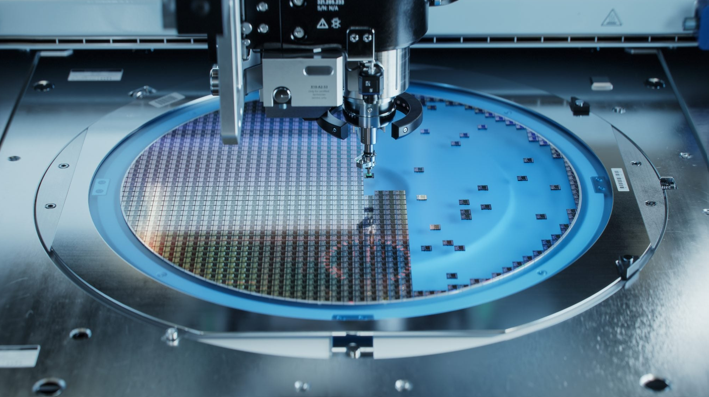
Advanced Packaging is full of bottlenecks
GPU sales by chip designers like Nvidia are limited by how many chips can be assembled into a finished module. Materials and equipment involved in the process are controlled by a small number of companies, and concentration leads to price controls and occasional opportunities for share grab.
Ajinomoto controls >95% of the substrate film, based on which packages are built.
That film is made into a finished substrate at one of three companies (Ibiden, Unimicron, and Shinko Electric), which make ~75% of the world's supply.
TSMC uses those substrates for packaging, holding ~95% of capacity.
Around this chain sit further constraints: the equipment that bonds chips together (Kulicke & Soffa, BE Semiconductor), the cooling systems required to manage over 1,000W per chip, and the optical connections moving data (Corning, Lumentum, Coherent).
Four developments below show where these bottlenecks are playing out now, and which companies are leading in each case.
1. The substrate layer raises prices
Ajinomoto ($AJNMY on OTC) controls over 95% of the global ABF (Ajinomoto Build-up Film) market, the resin base for advanced IC substrates. It raised prices ~30% for Q3 2026, a cost shock to the tier below it. Three companies (Ibiden, Unimicron, Shinko Electric) control ~75% of that substrate manufacturing tier, all suppliers to Nvidia, Intel, Google, and Amazon.
On August 28, 2026, Taiwanese prosecutors raided Unimicron’s headquarters over allegations that China-made circuit boards were relabeled as Taiwan-origin. Unimicron says the disputed products are conventional PCBs, not advanced substrates, and reports no material operational impact. This introduces uncertainty: if major customers shift orders, Kinsus Interconnect and Nan Ya PCB are the beneficiaries.
Leading companies: Ajinomoto (film), Ibiden, Unimicron, Shinko Electric, Samsung Electro-Mechanics, Nan Ya PCB, Kinsus Interconnect (substrate manufacturing).
2. Glass replacing organic substrates and silicon interposers (slowly)
As chips get more complex (more chiplets, more memory stacked together), the substrate underneath needs more electrical wiring squeezed into the same physical area to carry signals between components. Glass allows finer, more precisely placed wiring than the organic (resin-based, ABF) substrates, so that more connections fit into a small package before signals start interfering with each other.
During manufacturing materials expand and contract at different rates as they’re heated and cooled during processing, and if a substrate warps even slightly, the microscopic connections can misalign or crack.
This gets worse as packages get bigger, because AI chips increasingly combine multiple dies (a GPU plus several memory stacks) side by side. Both silicon interposers and organic ABF substrates have limits on how large they can be made before warpage becomes unmanageable.
Glass resists this failure better. It expands predictably when heated and holds its shape at larger sizes where other materials fail.
This is moving past research into production, though the pace is mixed.
Intel, Samsung, and Rapidus are turning glass into finished interposers and substrates. None of them make the raw glass itself, they buy it from someone first. Three companies have different starting positions (an established chipmaker, a memory/packaging leader upgrading an existing product, and a brand-new foundry), all considering glass substrate.
Intel ( INTC -0.61%↓ ) demonstrated a working glass-core sample combined with its EMIB packaging technology at NEPCON Japan in January 2026. At ECTC 2026 in June, Intel Foundry unveiled “EMIB-T,” a more advanced variant for ultra-large chiplet systems, backed by reliability data showing copper-filled through-glass vias surviving severe thermal cycling. Separately, Intel is reportedly targeting its Rio Rancho, New Mexico facility for the world’s first glass substrate output. Google, Meta, and MediaTek are named in trade press as companies considering Intel’s EMIB technology.
Absolics (subsidiary of SKC Co., Ltd. trading under 011790 on the Korea Exchange) installed equipment at its Georgia facility and began shipping samples in January 2026, with further samples confirmed under reliability evaluation in Taiwan at SKC’s July 2026 earnings call. AMD is widely reported as the customer. More cautionary signals emerged: Absolics is reconsidering its second-phase expansion given soft initial order volumes, and a second customer has reportedly paused its testing.
Samsung's I-Cube and H-Cube existing 2.5D packaging solutions available since 2021, with H-Cube developed jointly with Samsung Electro-Mechanics and Amkor Technolog, run on conventional silicon interposers and hybrid substrates. The glass-substrate work is coming from Samsung Electro-Mechanics (SEMCO), a separate entity from Samsung Foundry. SEMCO's glass program has reportedly faced delays, with Korean press describing slipped reliability milestones and a 2028-or-later timeline that is not confirmed.
Rapidus, a newer, Japan-government-backed chip manufacturer built to establish a leading-edge foundry in Japan. It’s pursuing glass-interposer research as part of building out its manufacturing capability from scratch.
Companies below work on specialised raw glass material, “low-CTE” glass, engineered to expand and contract at a controlled rate when heated (CTE = coefficient of thermal expansion). This property matters because if the glass expands at a different rate than the silicon chips sitting on it, the whole package can crack or misalign under heat, the “warpage” problem glass is supposed to solve.
Corning Inc (GLW -1.28%↓ ) is the most vertically integrated of the three, with product lines built for this market (Semiconductor Glass Wafers and Advanced Packaging Glass Carriers) using its proprietary fusion process. Corning offers a portfolio of CTEs, letting customers tailor the expansion rate to their specific chip design. Its glass is transparent, which enables a laser de-bonding process during manufacturing that reduces the risk of chip breakage compared to mechanical separation methods.
It’s producing panels in the 515×510mm and 600×600mm sizes the industry is standardizing on for panel-level packaging. Corning has Nvidia partnership for optical connectivity (different business inside the same company).
AGC Inc (OTC: ASGLY; TYO: 5201) specialises in precision via drilling. AGC achieves sub-100-micron via holes, the channels drilled through the glass to route electrical connections. Company emphasizes precision via processing and thermomechanical stability as its value proposition, rather than competing on CTE range the way Corning does.
AGC Inc has ~22% market share, the top five players (AGC, Corning, Schott, Hoya Corporation, and Plan Optik) held ~73% of the market
Schott AG (private) brings >140 years of specialty glass and glass-ceramics expertise from outside the semiconductors. Its core businesses span pharmaceuticals, optics, and aerospace, and has translated that into a recentproduct launch: a low-loss glass formulation, aimed at high-frequency advanced-packaging applications.
Schott's progress has been slower than others'. Its most recent product announcement, a low-loss glass formulation for high-frequency packaging, dates to September 2024, and remains described by the company as "available as R&D material" rather than a commercial product.
Leading companies: Intel, Corning, SKC, Samsung, AGC.
3. Thermal management has become a major design constraint
AI accelerators now exceed 1,000W per chip, pushing the industry toward liquid cooling and surfacing a newer problem: thermal crosstalk between chiplets packed more densely than designs anticipated.
In a September 2026 interview with Digitimes, Mou-Shiung Lin, an early TSMC executive, who helped create the advanced-packaging era, credited Nvidia CEO Jensen Huang with single-handedly ushering in the modern "age of AI" through visionary hardware demand. He described the brute-force scaling behind the chip design and advanced packaging era required to handle high-power demands as “violent”.
The “Violent” Methodology: Despite the industry’s success, Lin characterizes the methodology power-scaling Nvidia’s AI chips as reliant on raw brute force. Rather than clean, elegant efficiency leaps, the industry is forcing performance gains through sheer scaling, high thermal density, massive advanced packaging structures, and extreme power usage.
The “1,000-Watt Problem”: The core theme highlights the immense power and thermal challenges faced by modern AI processors as single chips and high-density chiplet modules approach or exceed 1,000 watts of power consumption. Managing this level of power dissipation pushes advanced packaging, cooling, and foundry manufacturing to their physical limits.
Liquid cooling is projected to reach 53% of high-end AI infrastructure in 2026, confirming this isn’t a niche shift but close to becoming the standard.
Jentech (TWSE:3653) is currently the sole supplier of heat spreaders for Nvidia’s Rubin platform — a single-company concentration point sitting inside Nvidia’s next-generation GPU thermal design.
In contrast to the other three trends: unlike ABF substrate (Ajinomoto’s 95%+ share) or the substrate manufacturing tier (top 3 ~75%), liquid cooling is fragmented. Vertiv, the leader, holds ~3% market share, Schneider Electric, Rittal, Delta Electronics, 3M, and others each hold ~1-2%. Jentech’s Rubin-specific concentration is the one real exception.
Vertiv (VRT -2.75%↓ ) is a leader with its CoolChip CDU family spans roughly 70 kW to 2.3 MW units, covering direct-to-chip cooling, rear-door heat exchangers, and coolant distribution at hyperscale.
Boyd Corporation (private), specifically its Boyd Thermal division is focused on thermal management and environmental sealing, specializing in cold plates, heat exchangers, liquid cooling hardware, and thermal interface materials (TIMs).
The space is consolidating fast: Trane Technologies acquired LiquidStack in March 2026, gaining direct-to-chip and immersion cooling capability; Ecolab acquired CoolIT, combining water-treatment chemistry with rack-level hardware, with a combined platform planned for launch at Supercomputing 2026 in November, a catalyst worth watching.
Interesting companies: Jentech, Vertiv.
4. The optics layer is splitting into competing architectures
Co-packaged optics (CPO) places the optical engine (electrical-to-optical converter) directly on the same package as the switch or GPU, cutting the electrical path to millimeters and delivering the largest possible power savings (Broadcom claims a 70% reduction).
Near-packaged optics (NPO) is a compromise: the optical engine sits nearby on the same board rather than the same package, keeping it field-serviceable while still capturing most of CPO’s power benefit.
A mid-2026 SemiAnalysis research note pushing CPO volume expectations from 2026-2027 to 2028-2029 knocked 17% off Applied Optoelectronics, Inc (AAOI) and roughly 8% off Lumentum (LITE) in a single session. Both names were scored in this series’ earlier InP research.
Bottlenecks Cited by SemiAnalysis
- Yield Math on Optical Engines: Integrating 32 COUPE optical engines onto a single Nvidia Spectrum-6 switch chip yields an overall system success rate of roughly 19.4% (assuming a 95% yield per individual optical engine).
- Insertion Loss Issues: Engineering challenges like on-board insertion loss exceeding 3.5 dB on early optical engine iterations exhausted the optical channel budget, impacting performance.
- Hyperscaler Serviceability Concerns: Cloud service providers (CSPs) lack field-repair capabilities for failed optical engines embedded directly inside switch packages, causing hesitance to adopt CPO over traditional pluggable optics in 2026–2027.
Leading companies - CPO:
Broadcom Inc. (AVGO): +3/10 LONG
Lumentum Holdings Inc. (LITE): +5/10 LONG
NPO:
Broadcom and Credo Technology Group Holding Ltd (CRDO): +4/10 LONG
Corning ( GLW -1.28%↓ ), provides the fiber connectivity layer underneath either approach.
Corning and Nvidia Partnership
On May 6, 2026, Nvidia and Corning announced a long-term partnership under which Corning will expand its U.S.-based optical connectivity manufacturing capacity by 10x. The deal confirmed in Corning’s SEC filing, is unusually rich: Nvidia paid $1B customer deposit securing supply through December 31, 2029, received a warrant to buy 15M Corning shares at $180 ($2.7B), and separately paid $500M cash for a warrant covering 3M more shares at nominal cost.
Corning’s Optical Communications segment grew 32% YoY in Q2 2026 (Enterprise Networks up 65%), with management citing Gen AI demand as the driver.
Corning’s stock reflects this: a 52-week range of $76.15 to $271.78 — a rally of roughly 257%. Confirmed Q2 2026 results: core sales +17% YoY, core EPS +30%. Confirmed Strong Buy analyst consensus (13 Buy and 0 Sell).
In a similar investment, Nvidia locked in supply for its hardware, with an equity stake in Lumentum and Coherent (invested $2B into each).
What to Invest In
Across the four names scored in this series, the finding was that the strong execution consistency mattered more than other factors.

TSM and KLIC remain the cleanest, most direct plays — both delivered uninterrupted execution.
Two candidates (AEHR and AMAT) were checked and set aside.
AEHR Test Systems ( AEHR -5.19%↓) , up ~800% was dropped after current fundamentals showed revenue growth had reversed to -13.7% with negative margins across the board.
Applied Materials ( AMAT -2.94%↓), shows a confirmed quarterly inflection (two quarters of decline, then reacceleration) but a fundamental profile netting close to zero and bearish options positioning.
Corning (GLW -1.28%↓ ) is an interesting name, sitting at the intersection of two separate trends (glass substrates and optical connectivity), with a 640% rally and 58% retest pattern, Nvidia partnership behind it, and a Strong Buy consensus. Its revenue is a 19% TTM, marginally below peers, with cashflow growth driven by exceptional cash from Nvidia partnership. Options are bearish. Score +2/10.
Ajinomoto ($AJNMY on OTC, the ABF substrate chokepoint) is a food and seasoning conglomerate first, with an active legal investigation now adding uncertainty to the substrate tier.
Bottom Line
The bottlenecks are not resolving — a raid on a top-three substrate maker, a named industry veteran calling current scaling “violent,” and a research note that moved two stocks by double digits in a single session are all examples from recent weeks. On the evidence gathered across this entire series, TSM and KLIC remain the highest-conviction way to hold the thesis.
This article synthesizes findings from this series’ four scored reports (TSMC, Kulicke & Soffa, ASE Technology, Teradyne) alongside research into substrate, glass, thermal, and optical-connectivity trends, gathered via company filings, SEC filings, and industry reporting. It is for informational purposes only and does not constitute investment advice.